
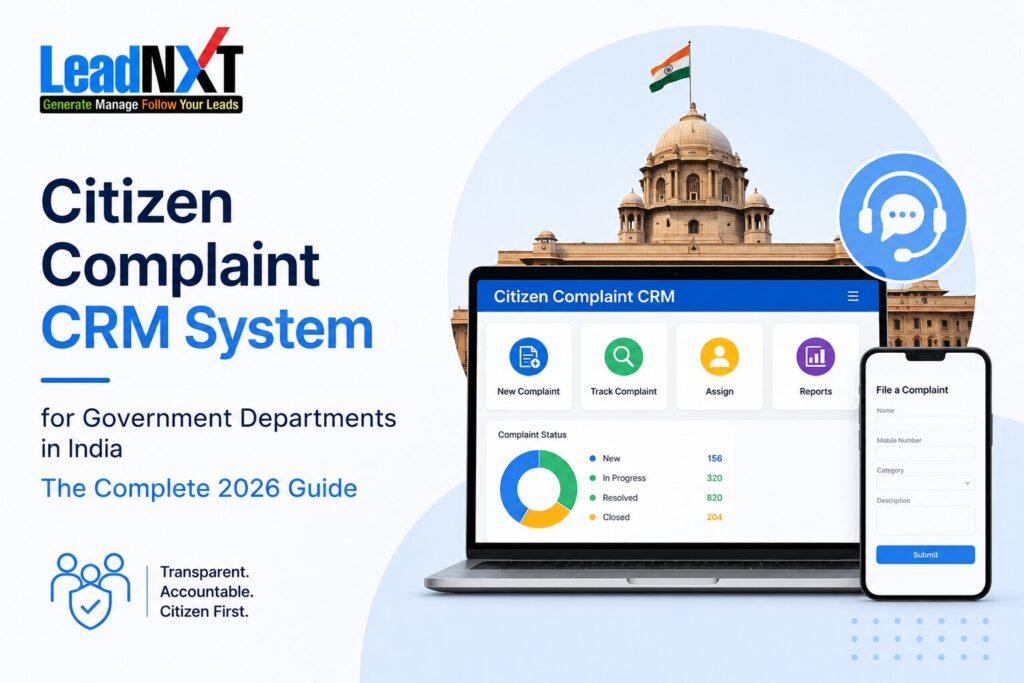
India’s 1.4 billion citizens are more connected, more vocal, and more demanding of government accountability than ever before. From potholes in a Tier-3 municipal ward to broken water pipelines in a smart city, every unresolved complaint is a vote of no-confidence in the administration that receives it. Yet most government helpdesks still run on spreadsheets, paper registers, or disconnected email inboxes – tools that cannot scale, cannot enforce SLAs, and certainly cannot produce RTI-ready audit trails on demand.
The Digital India mission has dramatically shifted citizen expectations. CPGRAMS (Centralized Public Grievance Redress and Monitoring System) at the Centre, combined with state-level portals like Sampark (Haryana), Jansamarth (MP), and CM Helplines across several states, has trained citizens to expect a ticket number within minutes and a resolution within days. Government bodies that lag behind this expectation face escalating social media backlash, political pressure, and mounting RTI applications.
A purpose-built Citizen Complaint CRM System is no longer a luxury for progressive administrations – it is infrastructure, as essential as a civic water supply or a road. This guide covers everything government IT heads, municipal commissioners, and state department PMUs need to know when evaluating, procuring, and deploying a citizen complaint CRM system in 2026.
What is a Citizen Complaint CRM System?
A Citizen Complaint CRM System (sometimes called a grievance management system or public complaint software) is a centralized software platform that captures, categorises, assigns, tracks, and resolves complaints and service requests received from members of the public by a government body.
Unlike commercial CRM tools designed for sales pipelines, a citizen complaint CRM is built around the lifecycle of a public grievance:
- Intake – Receive complaints from multiple channels: toll-free helpline, IVR, SMS, WhatsApp, web portal, mobile app, or walk-in kiosk.
- Triage and categorisation – Auto-classify complaints by department, subject, geography, and severity using rule-based or AI-assisted routing.
- Assignment – Route tickets to the correct officer, ward, zone, or department based on predefined workflows.
- Action and escalation – Enforce SLA timers, trigger escalation chains when deadlines are missed, and notify supervisors automatically.
- Resolution and closure – Capture resolution notes, attach geotagged photographs as proof, and confirm closure with the complainant via SMS or call-back.
- Reporting – Generate real-time dashboards, historical trend reports, and audit logs suitable for RTI responses and internal performance reviews.
The best systems in India are also channel-agnostic, language-aware (supporting Hindi, regional languages, and English), and deployable on both cloud and on-premise infrastructure to satisfy data localisation requirements under the Digital Personal Data Protection Act 2023 (DPDP).
LeadNXT’s Citizen Complaint CRM System is engineered specifically for the Indian government context, with native support for CPGRAMS integration, GeM-compatible licensing, and a multilingual IVR engine that handles calls in 12+ regional languages.
Why Government Bodies Need a Complaint CRM System in 2026
Scale That Spreadsheets Cannot Handle
A single district collectorate in UP or Bihar may receive 2,000 to 10,000 complaints per month across helplines, walk-ins, and WhatsApp. At municipal corporation level in metros like Greater Mumbai or BBMP Bengaluru, that number can cross 50,000 monthly complaints during peak periods (monsoon flooding, elections, utility disruptions). No spreadsheet, no email thread, and no manual register can track that volume without grievances slipping through the cracks permanently.
Statutory SLA Obligations
Multiple government orders and service guarantee acts across Indian states mandate specific turnaround times for public complaints. The Right of Citizens for Time Bound Delivery of Services Act has been enacted in over 20 states. Violations attract penalty, and repeated failures invite CAG scrutiny. A CRM system with built-in SLA timers and escalation engines is the only way to enforce these obligations systematically rather than depending on individual officer diligence.
RTI Readiness
Under the Right to Information Act 2005, any government body can receive RTI applications asking for records of every complaint received in a given period, action taken, officers responsible, and resolution timelines. Departments running on paper registers or ad-hoc email threads cannot produce this information without weeks of manual compilation. A CRM system produces RTI-ready reports in minutes, reducing the compliance burden while improving transparency.
Transparency and Public Trust
The Indian public increasingly compares government service delivery against private sector benchmarks. An automated SMS acknowledgement with a ticket number, a status-check link, and a resolution SMS on closure mirrors the experience citizens get from booking a cab or placing an e-commerce order. This parity of experience is now a political imperative, not just a convenience.
DPDP and Data Privacy Compliance
The Digital Personal Data Protection Act 2023 requires government bodies handling citizen data to follow strict data minimisation, consent, and retention rules. A purpose-built CRM enforces these controls at the platform level, rather than relying on individual officers to respect privacy guidelines.
Must-Have Features of a Citizen Complaint CRM System
1. Omnichannel Complaint Intake
Citizens complain through the channel that is most convenient for them. An effective grievance management system India must support all of these:
- Toll-free helpline integration – Calls landing on 1800-XXX-XXXX are auto-logged as tickets, with call recording and caller ID captured. See LeadNXT’s Toll-Free and IVR services for government-grade helpline infrastructure.
- Missed call registration – Citizens dial a designated number and disconnect; the system registers a ticket and calls back automatically. Learn more about LeadNXT’s Missed Call Alert Service.
- WhatsApp intake – Citizens send a WhatsApp message to a government number; an AI chatbot collects complaint details, category, and location before creating the ticket. See LeadNXT’s WhatsApp Business API and AI Chatbot.
- Web portal form – Embeddable form on the government website or dedicated citizen portal with photo/document attachment support.
- SMS registration – Citizens SMS a keyword to a short code or long code to log a complaint, even on basic feature phones.
- IVR self-service – Caller navigates an IVR menu to log a complaint, check status, or re-open a closed ticket without speaking to an agent. LeadNXT’s IVR service provider platform supports DTMF and voice input in multiple languages.
- Mobile app – Android/iOS app for citizens with GPS-enabled complaint geotagging.
- Walk-in kiosk or CSC integration – For citizens without smartphones, Common Service Centre operators can log complaints on their behalf.
2. Intelligent Ticket Lifecycle Management
- Unique ticket number generated on complaint receipt, shared with citizen via SMS.
- Auto-classification by complaint type, department, ward/zone, and urgency level.
- Rule-based or AI-based routing to the responsible officer or department.
- Status transitions: New – In Progress – Pending Site Visit – Resolved – Closed – Re-opened.
- Citizen-initiated re-open within a defined satisfaction window (typically 7 days after closure).
- Full audit log of every status change, officer action, and note.
3. SLA Timers and Escalation Matrix
- Configurable SLA targets by complaint category (e.g., broken streetlight: 48 hours; water supply disruption: 6 hours; property grievance: 30 days).
- Visual SLA countdown per ticket with colour-coded status (green/amber/red).
- Multi-level escalation matrix: if not resolved in X hours, escalate to supervisor; if not resolved in Y hours, escalate to department head; if not resolved in Z hours, escalate to commissioner/secretary.
- Automated WhatsApp, SMS, and email escalation alerts to the escalation chain.
- Dashboard view of all SLA-breached tickets by department and officer.
4. Geotagging and Proof of Resolution
- Officers field-close tickets from a mobile app with a geotagged photograph of the resolved issue.
- System validates that the photo coordinates match the complaint location within a configurable radius.
- Proof of resolution is stored against the ticket and visible to the citizen and supervisors.
5. Public Transparency Dashboard
- Optional public-facing dashboard on the government website showing complaint volumes, resolution rates, and average resolution time by category and ward.
- Builds public trust and discourages frivolous re-complaints.
- Powers citizen-facing complaint status check by ticket number (web or IVR).
6. Multilingual Support
- IVR menus, SMS acknowledgements, and WhatsApp bot interactions in Hindi plus state regional language(s).
- Agent interface available in English and Hindi.
- Complaint category names and resolution messages configurable in local language.
7. Role-Based Access Control
- Granular roles: citizen (portal access only), field officer, supervisor, department admin, IT admin, commissioner/viewer.
- Officers see only tickets assigned to their zone or department.
- Supervisors see their team’s tickets and SLA performance.
- Department admins configure routing rules and SLA targets for their department.
- Commissioner dashboard shows organisation-wide KPIs.
Top Channels Citizens Use to Complain to Government Bodies
Understanding channel preference by citizen segment helps government bodies prioritise their investment in complaint intake infrastructure.
Toll-Free Helpline (1800 Numbers)
The toll-free call remains the dominant complaint channel for citizens above 40 and in rural areas where data connectivity is limited. Central government ministries and most state CM helplines run on 1800 numbers. The challenge is agent capacity: helpline volumes spike unpredictably during monsoon, election cycles, or major civic events. A cloud-based helpline backed by an IVR self-service layer can absorb spikes without adding headcount.
Explore LeadNXT’s Toll-Free Number Services guide to understand infrastructure requirements for government helplines at scale.
Missed Call Service
Missed call complaint registration is extremely popular in rural India and among feature phone users. Citizens dial, disconnect after one ring, and receive an automated call-back or SMS acknowledgement. This eliminates the cost of the call for the citizen (important for daily-wage earners) while ensuring the complaint is logged. The complete guide to Missed Call Alert Services covers implementation for government bodies.
WhatsApp penetration in India exceeds 550 million monthly active users. Government bodies that open a verified WhatsApp Business API channel for complaints see rapid adoption, especially among the 18-45 urban and semi-urban citizen segment. An AI chatbot on WhatsApp can handle complete complaint intake – from collecting the issue description and address to sharing the ticket number – without any agent involvement, freeing helpline staff for complex queries.
Web Portal
State government portals and municipal websites carry significant organic traffic. A well-designed complaint submission form that is accessible, mobile-responsive, and available in the local language is a significant intake channel. Integration with the CRM backend ensures web-submitted complaints flow into the same queue as phone-received ones, with no manual re-entry.
IVR Survey (Post-Resolution Satisfaction)
While not an intake channel, IVR surveys are a crucial feedback channel. After a ticket is marked resolved, an automated IVR call to the complainant asks: “Were you satisfied with the resolution? Press 1 for Yes, Press 2 for No.” A “No” response can automatically re-open the ticket and alert the supervisor. This simple loop dramatically improves first-resolution rate and citizen satisfaction scores.
LeadNXT’s IVR Service Provider platform includes post-resolution survey templates specifically designed for government complaint workflows.
How LeadNXT Citizen Complaint CRM Works: Architecture Overview
LeadNXT’s Citizen Complaint CRM System is a cloud-native, API-first platform with the following architecture:
Intake Layer
Multiple intake channels (toll-free IVR, WhatsApp, SMS, web form, mobile app, walk-in kiosk) feed into a unified Intake API. Each incoming complaint is normalised into a standard ticket object regardless of originating channel. This single-queue model eliminates the common problem of channel silos where a WhatsApp complaint and a phone complaint about the same broken streetlight are never linked.
Intelligence Layer
The intake API passes every ticket through a classification engine that uses keyword matching, location parsing, and (on higher tiers) NLP-based categorisation to assign:
- Department or ward owner
- Complaint category from a configurable taxonomy
- Priority level based on category and volume rules
- SLA target clock start time
Duplicate complaints about the same issue are auto-clustered so officers see one consolidated complaint rather than 47 separate tickets about the same pothole.
Workflow and SLA Layer
The routing engine assigns tickets to the right officer or team and starts the SLA countdown. All escalation rules, supervisor chains, and notification preferences live here. Government IT teams configure this layer through a no-code workflow builder, without needing to raise a change request with the vendor.
Resolution Layer
Officers access tickets through a web dashboard or mobile app. They can:
- Add progress notes
- Request field verification
- Attach photos (with GPS metadata)
- Mark tickets resolved with a resolution category
- Request supervisor approval before closure on complex cases
Feedback Layer
Post-closure IVR survey calls and SMS satisfaction polls go out automatically. Negative feedback re-opens the ticket. Aggregated satisfaction scores feed the reporting layer.
Reporting Layer
Real-time dashboards for every role tier. Scheduled email reports. Export to Excel/PDF for RTI and audit needs. API connectors to state dashboards and CPGRAMS.
The platform is available as SaaS (hosted on AWS India region, Mumbai) or on-premise deployment on government data centre infrastructure (NIC, NICSI, or department-owned). Both deployment modes are supported under GeM portal procurement.
Explore LeadNXT’s Government and Public Sector solutions page for a full product overview.
Use Cases by Government Tier
Urban Local Bodies (Municipal Corporations and Municipalities)
Municipal corporations handle the widest variety of citizen complaints: roads, drainage, water supply, solid waste, street lights, building permissions, health inspections, and more. A complaint CRM at this tier must support:
- Ward-level ticket assignment (complaint in Ward 42 goes to the Ward Officer of Ward 42, not a central inbox)
- Zone-level supervisor dashboard
- GIS integration to map complaint density by area
- Integration with asset management systems (a broken streetlight ticket should auto-link to the streetlight’s asset record)
- Monsoon readiness: ability to handle 5-10x normal volume during flood season without system degradation
Major use cases in municipal bodies include the BBMP (Bengaluru), MCGM (Mumbai), GHMC (Hyderabad), and PMC (Pune), all of which have run their own helplines – some of which are now being modernised with CRM backends.
State Government Departments
State departments – revenue, agriculture, education, health, labour, transport – each receive department-specific complaints. A state-level CRM must:
- Support multi-department ticket routing from a single helpline (the caller does not know which department to call)
- Enable CM Helpline integration (many states run a CM-branded helpline that escalates to departments)
- Support Tehsil/Block/District hierarchy for complaint assignment and reporting
- Allow departments to configure their own SLAs and escalation chains independently
Central Government PSUs and Ministries
PSUs like state electricity boards (DISCOMs), water boards, and departments like Posts, Railways (at regional level), and Passport Seva run large-scale complaint operations. Key requirements:
- High-volume IVR handling (millions of calls per month for major utilities)
- Multi-region deployment for organisations with pan-India footprint
- CPGRAMS API integration (mandatory for many central entities)
- DPDP-compliant data handling with documented consent mechanisms
Gram Panchayats and Rural Local Bodies
Rural grievance redress is the frontier for Digital India. Smartphone penetration is growing fast in rural India, but voice and SMS remain dominant channels. A CRM system for Gram Panchayats must:
- Work on basic internet connections or even offline with sync capability
- Support Panchayat Secretary as the primary ticket manager (not a trained CRM operator)
- Integrate with PM-Gram Sadak Yojana, MGNREGS, and other scheme complaint channels
- Be affordable at the Gram Panchayat budget scale (models discussed in the Pricing section below)
SLA Management and Escalation Workflows
SLA management is where most government complaint systems fail. The typical failure mode: officers receive tickets in a shared inbox, SLA deadlines are manual calendar entries (if they exist at all), and escalation depends on a supervisor manually reviewing the inbox and noticing overdue tickets. By the time anyone escalates, the SLA has been breached by days.
LeadNXT’s SLA engine eliminates this failure mode through automation:
SLA Configuration
Administrators configure SLA targets by:
- Complaint category (e.g., “Pothole on arterial road: 5 working days”, “No water supply: 4 hours”, “Illegal construction: 15 days”)
- Priority tier (P1 emergency, P2 urgent, P3 normal, P4 low)
- Organisational tier (ward level, zone level, department level)
- Calendar type (working days only, or 24×7 for emergencies)
Automated Escalation Chains
A sample escalation chain for a municipal corporation:
| Time Elapsed | Action |
|---|---|
| T+0 | Ticket assigned to ward officer, SMS notification sent |
| T+50% SLA | Reminder SMS to ward officer |
| T+100% SLA (breach) | Auto-escalate to zone supervisor, alert sent via WhatsApp and email |
| T+150% SLA | Auto-escalate to deputy commissioner, daily escalation summary sent |
| T+200% SLA | Flag on commissioner dashboard, appears in daily exception report |
All escalation messages include the ticket number, complaint summary, original assignment date, and breach duration – so escalation recipients have full context without needing to log into the system.
SLA Pause and Extension
Real-world government complaints sometimes require a pause (waiting for a court order, pending land acquisition, dependency on another department). The system supports:
- Supervised SLA pause with mandatory reason code
- Automatic resume when the blocking condition is removed
- Extension requests that require supervisor approval with an audit trail
Real-Time SLA Dashboard
Every supervisor and above gets a live SLA health dashboard showing:
- Tickets within SLA (green count and percentage)
- Tickets approaching breach (amber)
- Tickets breached by less than 24 hours (red)
- Tickets severely overdue (dark red, attention required)
- Trend: is the SLA compliance rate improving or declining week-on-week?
Reporting and Accountability Features
RTI-Ready Reports
The most critical reporting requirement for government complaint CRMs is RTI compliance. LeadNXT’s reporting module generates:
- Complaint Register Report: All complaints received in a date range, with ticket number, date-time, channel, complainant ID (masked or unmasked), category, assigned officer, and resolution date.
- Resolution Report: Resolution rate by category and department for any period.
- Officer Performance Report: Tickets handled, average resolution time, SLA compliance rate, and citizen satisfaction score by officer.
- Escalation Report: All tickets that required escalation, escalation level reached, and reason codes.
- Pending Grievance Report: All unresolved complaints as of a given date, with age and breach status.
All reports are exportable as PDF or Excel and include a system-generated digital signature for official use.
Audit Logs
Every action on every ticket is immutably logged:
- Who created the ticket, when, from which channel
- Every status change, with timestamp and actor identity
- Every note added, attachment uploaded, or communication sent
- Every SLA pause or extension, with reason and approving authority
- Every escalation triggered
- Every closure and re-open
Audit logs cannot be edited or deleted by any user including administrators. This creates an unbroken evidence chain for accountability purposes.
Public Accountability Dashboards
LeadNXT supports an optional public-facing accountability module that publishes aggregate statistics on the government department’s website:
- Total complaints received this month
- Average resolution time
- Resolution rate (percentage closed within SLA)
- Top complaint categories
- Ward/zone-wise performance heatmap
Public dashboards have been proven to reduce complaint volumes by 15-25% in municipalities that deploy them (citizens see the system works, so they use it; visibility also motivates officers to close tickets promptly).
Integration with State Monitoring Systems
Many state governments run monitoring dashboards (e-Samiksha, e-Dharti at NIC, custom CMO dashboards) that aggregate data from multiple departments. LeadNXT’s API layer provides ready connectors for:
- Real-time ticket volume and SLA data feeds to state monitoring portals
- Bulk export in formats required by NIC and state IT departments
- Webhook-based real-time event notifications for high-priority ticket status changes
Pricing Model for Government Deployments
Government procurement in India follows budget cycles, tendering norms, and increasingly, the GeM (Government e-Marketplace) portal. LeadNXT’s pricing is structured to support all of these.
Pricing Tiers (Indicative, Excluding GST)
Starter Plan – Municipal Bodies and Small Departments
- Up to 5,000 complaints per month
- Up to 20 agent seats
- Channels: Web, SMS, 1 IVR line
- SLA engine and basic escalation
- Standard reports
- Price: Starting from Rs. 25,000 per month (billed annually)
Professional Plan – State Departments and Medium Municipal Corps
- Up to 50,000 complaints per month
- Up to 100 agent seats
- Channels: Web, SMS, IVR (multi-line), WhatsApp Business API, missed call
- Full SLA and multi-level escalation engine
- RTI-ready reports, audit logs
- CPGRAMS API integration (optional add-on)
- Price: Starting from Rs. 1,20,000 per month (billed annually)
Enterprise Plan – State Governments, Large Utilities, PSUs
- Unlimited complaints
- Unlimited agent seats
- All channels including custom mobile app
- Full feature set plus custom workflow builder
- Dedicated implementation team and SLA guarantee from LeadNXT
- On-premise deployment option
- GeM-compatible licensing and procurement support
- Price: Custom proposal based on scope, typically Rs. 8 lakhs to Rs. 35 lakhs per year
Per-Citizen Licensing (for Large State Deployments)
Some state governments prefer per-citizen pricing that scales with the population served. LeadNXT offers a per-thousand-citizen annual licence model for state-wide deployments covering multiple departments. Contact the government sales team for a tailored quote.
GeM Portal Procurement
LeadNXT is registered on the Government e-Marketplace (GeM) portal. Government departments can procure the Citizen Complaint CRM System through GeM without a separate tender process for orders below the tendering threshold, significantly reducing procurement lead time (from 6-12 months via tender to 4-8 weeks via GeM).
For orders above the tendering threshold, LeadNXT has bid and won government RFPs and provides full support for the technical specification drafting, bid process, and implementation under the resulting contract.
Implementation Costs
Implementation is charged separately based on:
- Number of departments and complaint categories to configure
- Number of integrations required (CPGRAMS, state portal, GIS, asset management)
- Custom development requirements
- Training (onsite or virtual, by user tier)
- Data migration from legacy systems
Typical implementation costs for a medium municipal corporation: Rs. 3 lakhs to Rs. 8 lakhs as a one-time fee.
Integration with CPGRAMS and State Portals
What is CPGRAMS?
The Centralized Public Grievance Redress and Monitoring System (CPGRAMS) is the Government of India’s national grievance platform, operated by the Department of Administrative Reforms and Public Grievances (DARPG) and built on NIC infrastructure. All central ministries and departments are mandated to use CPGRAMS. State governments are encouraged but not uniformly mandated.
CPGRAMS Integration Architecture
LeadNXT integrates with CPGRAMS via the published CPGRAMS API in two modes:
Push Mode: Grievances received in LeadNXT from a ministry or department’s own helpline are automatically pushed to CPGRAMS with all required fields populated. The CPGRAMS ticket number is stored back in LeadNXT for cross-referencing.
Pull Mode: Grievances filed by citizens directly on the CPGRAMS portal and routed to a specific ministry or department are pulled into LeadNXT automatically, so the department’s officers work from a single queue rather than splitting their attention between the CPGRAMS interface and LeadNXT.
Status Sync: Resolution status updates made by officers in LeadNXT are reflected back to CPGRAMS in real time, so the citizen can check status on either platform.
State Portal Integration
Most state governments have their own grievance portals. LeadNXT has pre-built or configurable connectors for several state portals and can build new connectors as part of an implementation project. The typical integration points are:
- Complaint submission API (receive complaints from the state portal)
- Status push API (update complaint status on the state portal)
- Report API (provide aggregate data to the state’s monitoring dashboard)
NIC and NICSI Infrastructure
For government entities that require on-premise or NIC-hosted cloud deployment rather than a commercial cloud, LeadNXT’s platform can be deployed on:
- NIC’s MeghRaj Cloud (GI Cloud)
- NICSI-managed data centres
- Department-owned infrastructure (baremetal or virtualised)
All deployment modes support the same feature set, with configuration managed through LeadNXT’s centralised management console.
Case Study: Municipal Corporation Reduces Complaint Backlog by 68% with LeadNXT
Note: Client details are anonymised at the client’s request pending a formal case study approval.
Client: A Tier-1 municipal corporation in Western India, serving a population of approximately 4.2 million citizens across 148 wards.
Challenge: The corporation was running its citizen helpline on a basic EPABX phone system with calls logged manually into an Excel sheet. Complaint volumes averaged 18,000 per month. The backlog of unresolved complaints over 30 days old had grown to 14,200 tickets. The corporation had received over 800 RTI applications in the previous financial year requesting complaint records, each requiring 2-3 days of manual effort to respond to. Social media complaints tagging the mayor’s office were averaging 120 per week.
What LeadNXT Deployed:
- Integration of the existing toll-free number with LeadNXT’s IVR platform, enabling self-service complaint registration without agent involvement
- WhatsApp Business API channel with an AI chatbot handling 70%+ of complaint intake autonomously
- Full ticket lifecycle management with ward-level routing to 148 ward offices
- Three-level escalation matrix (Ward Officer – Zonal Deputy Commissioner – Additional Commissioner)
- SLA targets configured for 38 complaint categories
- Mobile app for 420 field officers with geotagged photo resolution
- Public accountability dashboard on the corporation’s website
- RTI report automation module
Results (6 Months Post Go-Live):
- Complaint backlog over 30 days old: reduced from 14,200 to 4,500 (68% reduction)
- SLA compliance rate: improved from an estimated 34% to 79%
- Average resolution time: down from 22 working days to 8.4 working days
- RTI response time for complaint-related applications: reduced from 3 working days to 4 hours (automated report generation)
- WhatsApp channel accounted for 41% of all complaint intake within 4 months, with zero additional agent headcount
- Citizen satisfaction score (post-resolution IVR survey): 72% positive
- Social media complaints dropped by 55% in Month 6 compared to pre-deployment baseline
Go-Live Timeline: 11 weeks from purchase order to live operations, including integration, data configuration, and training of 420 field officers and 68 supervisors.
For more on how CRM and lead/complaint management drives accountability, read LeadNXT’s CRM and Lead Management Guide and the Helpline Numbers for Support and Marketing guide.
Also explore LeadNXT’s detailed Citizen Complaint CRM overview for additional context.
Frequently Asked Questions (FAQ)
1. Can government departments procure LeadNXT through the GeM portal without a tender?
Yes. LeadNXT is listed on the Government e-Marketplace (GeM) under the relevant service categories for IT solutions and cloud services. Government entities can directly procure within the applicable financial limits without issuing a separate tender. For orders requiring a tender (above the direct procurement ceiling), LeadNXT provides full bid support including technical specification drafting and bid submission. Contact the government sales team at government@leadnxt.com for GeM catalogue details.
2. Is LeadNXT’s Citizen Complaint CRM compliant with the Digital Personal Data Protection Act 2023 (DPDP)?
Yes. The platform is designed with DPDP compliance as a core requirement for government deployments. Key compliance features include: data minimisation (only the fields required to resolve a complaint are collected), purpose limitation (citizen data collected for complaints is not used for any other purpose), configurable data retention policies (auto-deletion of personal data after the retention period), documented consent capture for voluntary data fields, and detailed data processing logs. For government entities acting as Data Fiduciaries under DPDP, LeadNXT provides a Data Processing Agreement (DPA) and supports the appointment of a Data Protection Officer as required.
3. Does the system support Hindi and regional language IVR and SMS?
Yes. The IVR engine supports voice prompts and DTMF interaction in Hindi and 12+ regional languages including Tamil, Telugu, Kannada, Malayalam, Marathi, Gujarati, Bengali, Odia, Punjabi, Assamese, and Urdu. SMS acknowledgements and WhatsApp messages can be templated in any language using Unicode encoding. Language selection can be automatic (based on the caller’s registered state/district) or offered as an IVR menu option (“Press 1 for Hindi, Press 2 for Marathi”).
4. How long does it take to implement the system?
Implementation timelines depend on scope. A typical municipal corporation deployment (single tier, 20-50 agent seats, standard channels, no custom integrations) goes live in 8-12 weeks from purchase order. A state-level multi-department deployment with CPGRAMS integration and custom state portal connectors typically takes 16-24 weeks. LeadNXT provides a detailed implementation project plan with milestones at the pre-sales stage.
5. Can the system be deployed on NIC MeghRaj or on government-owned data centre infrastructure?
Yes. LeadNXT’s platform is available in three deployment modes: SaaS on AWS India (Mumbai region), hosted on NIC MeghRaj Cloud (GI Cloud), and on-premise on government-owned or NICSI-managed infrastructure. All three modes support the same feature set. NIC MeghRaj deployment follows NIC’s empanelled hosting process, and LeadNXT provides all required technical documentation for NIC empanelment and MeityCloud onboarding.
6. How does the escalation engine handle situations where an escalation contact is unavailable (on leave, transferred)?
The escalation engine supports backup escalation contacts for every position in the escalation chain. Administrators can configure primary and up to two backup contacts per escalation level. When an escalation notification is triggered, the system checks officer availability (leave can be marked in the system) and routes to the designated backup if the primary is unavailable. For officers who have been transferred, the admin can reassign their tickets in bulk and update the escalation chain through the no-code configuration interface without vendor involvement.
7. Is there a citizen-facing mobile app, and is it available in Hindi?
Yes. LeadNXT provides an optional white-label citizen mobile app (Android and iOS) that government bodies can publish under their own brand name on the Play Store and App Store. The app supports complaint registration with photo and GPS attachment, ticket status tracking by ticket number or mobile number, and push notifications for status updates. The app is available in English and Hindi by default, with additional regional language packs available as a configuration option.
8. What SLA does LeadNXT provide for the platform itself (uptime)?
For SaaS and NIC MeghRaj deployments, LeadNXT commits to 99.5% monthly uptime under a standard government SLA, measured on a calendar month basis excluding scheduled maintenance windows (announced 72 hours in advance, limited to off-peak hours). Enterprise plan customers can negotiate a 99.9% SLA with financial penalties for breach. On-premise deployments do not include a platform uptime SLA from LeadNXT (as infrastructure is government-owned), but LeadNXT provides software support SLAs for issue resolution response times.
Conclusion: Make Citizen Grievance Resolution a Government Strength in 2026
India’s governance transformation is accelerating. Citizens equipped with smartphones, WhatsApp, and social media hold their local governments accountable in real time. Every complaint that slips through the cracks is not just an administrative failure – it is a signal that the administration does not respect the citizen’s time or trust.
A purpose-built Citizen Complaint CRM System turns the reactive, chaotic complaint process that most government bodies still run into a systematic, measurable, and accountable operation. With the right platform:
- No complaint gets lost. Every channel feeds a single queue.
- No SLA gets missed silently. Automated escalation surfaces breaches before they become crises.
- No RTI question takes days to answer. Reports are generated in minutes.
- No resolution goes unverified. Geotagged photos confirm field action before closure.
- No citizen goes unacknowledged. Automated SMS confirms receipt within seconds.
LeadNXT’s Citizen Complaint CRM System has been designed from the ground up for Indian government realities – multilingual IVRs, CPGRAMS integration, GeM procurement support, DPDP compliance, and on-premise deployment capability. Whether you are a municipal commissioner looking to clear a complaint backlog before the next election cycle, a state IT secretary building a CM Helpline infrastructure, or a PSU operations head modernising a customer grievance process, LeadNXT has the platform, the implementation expertise, and the government sector track record to deliver.
Request a government-specific demo today. Our government solutions team will walk you through a live configuration tailored to your department’s complaint categories, escalation hierarchy, and integration requirements – at no cost and no obligation.
Schedule a Government Demo – LeadNXT Citizen Complaint CRM
Or write to: government@leadnxt.com | Call: 1800-XXX-XXXX (toll-free, Monday to Saturday, 9 AM to 6 PM IST)
Related Reading:
Related Articles
Toll Free Services for 5 Different Business Use
Toll-Free has become a critical solution or branding, marketing, and customer interaction. It has grown…
Best Election Management Software in India 2026: Top 7 Platforms Compared
Indian democracy runs on scale that most of the world cannot comprehend. Over 96 crore…
Lead Management Software Simplifies the Sales Process
LeadNXT, the leading Cloud Telephony Services provider, offers the most effective and efficient Lead Management…