Indian democracy runs on scale that most of the world cannot comprehend. Over 96 crore registered voters, 543 Lok Sabha constituencies, 4,120+ state assembly seats, and lakhs of polling booths spread across mountains, deserts, forests, and megacities. As the country begins gearing up for the 2027 Lok Sabha elections, every political party, independent candidate, and campaign strategist is asking the same question: how do we reach, persuade, and mobilize voters faster and smarter than the opposition?
The answer increasingly lies in purpose-built election management software. Paper-based voter lists, manual booth coordination, and word-of-mouth mobilization are no longer enough in a competitive multi-party democracy where a margin of a few thousand votes decides whether a candidate wins or loses. Digital tools, automated calling systems, WhatsApp campaign engines, and real-time booth data are becoming the backbone of modern Indian political campaigns.
This guide compares the best election management software in India 2026, breaks down must-have features, explains ECI compliance requirements, and gives you a transparent pricing picture so your party or campaign team can make the right technology investment before the next election cycle.
What is Election Management Software?
Election management software (EMS) is a category of specialized political campaign technology designed to help candidates, parties, and campaign managers plan, execute, and monitor every phase of an election campaign. It is fundamentally different from general-purpose CRM or marketing platforms because it is built around the unique workflows of Indian elections.
At its core, election management software does the following:
- Stores and segments the voter database by constituency, booth number, caste group, age, and voting history
- Automates outreach through calls, SMS, WhatsApp, and IVR systems at crore-scale volume
- Coordinates ground teams including booth-level workers, panna pramukhs, and district coordinators
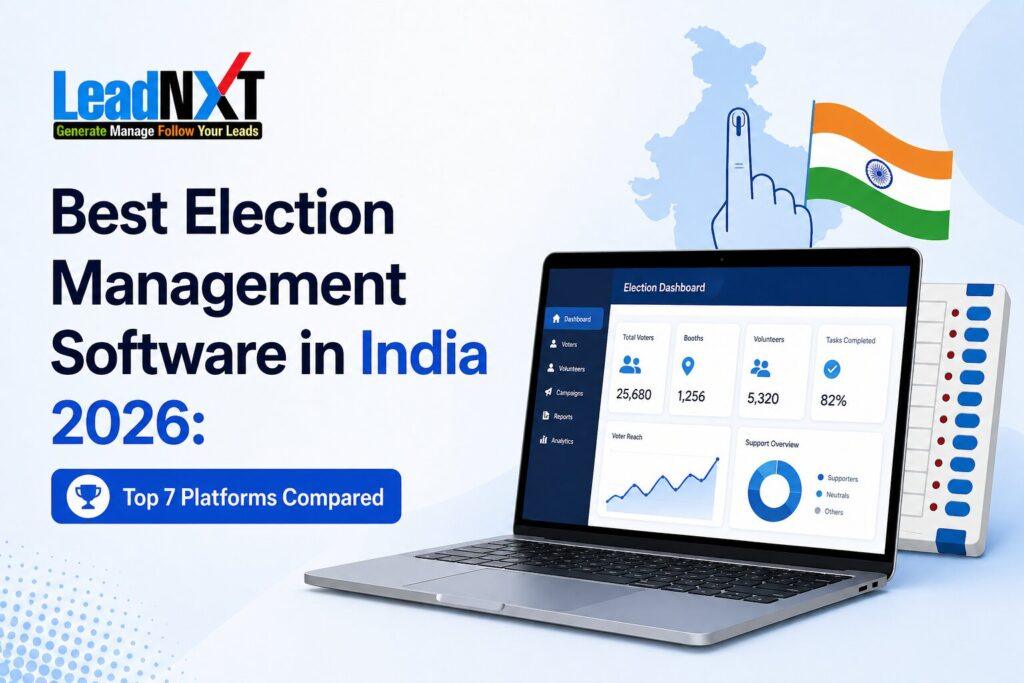
- Tracks campaign progress in real time with dashboards showing booth coverage, volunteer activity, and voter sentiment
- Supports decision-making with analytics, opinion poll data, and swing voter identification
Modern election management software from platforms like LeadNXT goes several steps further by integrating missed call voter verification, multilingual IVR surveys, and WhatsApp Business API to create a full-funnel campaign engine that works in Tier 1 cities as well as remote rural areas with limited connectivity.
The global political technology market is estimated to exceed $14 billion by 2027, but the India-specific market is growing even faster given the frequency of elections at central, state, and local body levels.
Must-Have Features for Indian Elections
Before comparing platforms, every campaign manager should build a feature checklist that matches the realities of Indian electioneering. Here are the non-negotiable capabilities:
1. Voter Database Management
India’s electoral rolls are complex. A single assembly constituency may have 2 to 4 lakh registered voters, organized across dozens of polling booths, multiple blocks, and several mandals or wards. Your software must be able to:
- Import voter lists in CSV, Excel, or API formats directly from the Election Commission of India (ECI) database
- Segment voters by booth, ward, page number, serial number, age group, gender, and community
- Tag swing voters, loyal voters, and anti-voters separately
- Track “dead” voters, shifted voters, and newly enrolled voters
- Flag duplicate and invalid entries automatically
Without a clean, deduplicated voter database, every downstream campaign activity from calling to doorstep canvassing becomes inefficient.
2. Poll Booth Management
The final days before an election are won or lost at the booth level. Software must support:
- Booth-level assignment of party workers
- Real-time voter slip distribution tracking
- Election day turnout monitoring with live counts from booth agents
- Identification of “sleeping” voters who have not come out to vote so far
- Coordination of voter pickup logistics
3. WhatsApp Campaign Integration
With over 60 crore active WhatsApp users in India, this platform is the single most effective channel for political messaging. The right election software integrates with the WhatsApp Business API to enable:
- Broadcast messages to segmented voter lists
- Multimedia content including videos, PDFs, voice notes, and images
- Two-way chatbot conversations for voter grievance collection
- Automated follow-up sequences for events, rallies, and voting day reminders
- Verified sender ID to avoid message blocking
See how WhatsApp Business API with AI Chatbot integration works within a political campaign context.
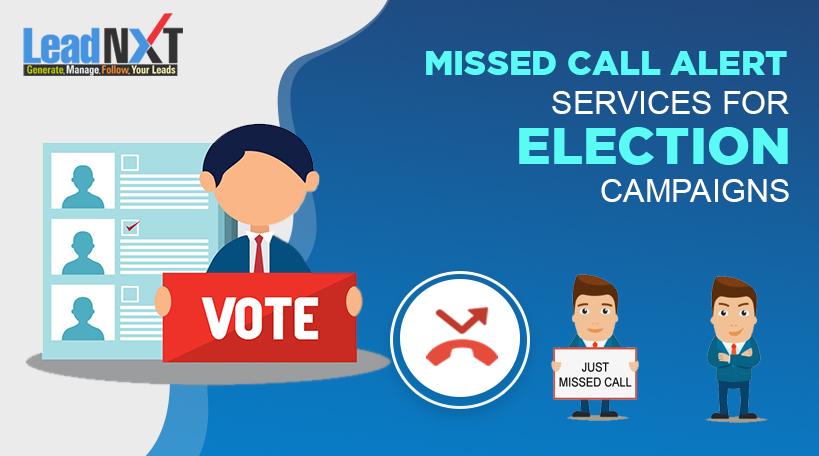
4. Missed Call Voter Verification and Engagement
The missed call channel is uniquely suited to Indian elections. Voters who give a missed call to a campaign number can be:
- Automatically enrolled as supporters
- Sent an auto-reply SMS or WhatsApp message with campaign content
- Routed to an IVR for a short opinion poll
- Tracked for follow-up by a field volunteer
This channel works in rural areas with 2G connectivity where smartphone-based apps fail. LeadNXT’s missed call alert service with WhatsApp notifications is specifically built for this use case. Read more about it in our complete missed call alert services guide.
5. IVR Surveys and Voice Broadcasts
Interactive Voice Response (IVR) systems allow campaigns to:
- Broadcast a recorded message from the candidate to millions of voters simultaneously
- Run automated opinion surveys where voters press 1 for yes, 2 for no
- Collect grievances in the voter’s own language
- Transfer high-priority voters to a live agent
When paired with regional language support, IVR becomes a powerful last-mile engagement tool. Learn more about IVR service capabilities for political campaigns.
6. Multilingual Support
India has 22 scheduled languages and hundreds of dialects. A campaign in Tamil Nadu cannot run its IVR scripts in Hindi. Your election management platform must support at minimum:
- Hindi, English, Tamil, Telugu, Kannada, Malayalam, Marathi, Bengali, Gujarati, Odia, Punjabi, and Assamese
- Language-based segmentation so voters automatically receive communication in their preferred language
- Transliteration support for SMS messages in regional scripts
Top 7 Election Management Software in India 2026
1. LeadNXT – Best Overall Election Management Platform
Website: www.leadnxt.com/election-management-software-system/
LeadNXT is India’s most comprehensive election management and political campaign platform, purpose-built for the complexity and scale of Indian elections. Unlike generic CRMs that have been retrofitted for political use, LeadNXT was designed from the ground up to handle the voter data workflows, communication channels, and real-time coordination that Indian campaigns demand.
Core strengths:
- Full voter database management with ECI roll import, deduplication, and multi-level segmentation
- Missed call voter registration and engagement system that works on basic feature phones
- WhatsApp Business API integration with AI chatbot for automated voter interaction
- IVR voice broadcast for outbound calls to lakhs of voters simultaneously
- Multilingual support covering 12+ Indian languages
- Poll booth management module with live election day tracking
- Political campaign CRM with candidate pipeline, volunteer management, and donation tracking
- Real-time dashboards with constituency-level and booth-level analytics
- ECI compliance features including mandatory 48-hour silence enforcement and advertiser disclosure logging
- Dedicated political party campaign management module for multi-constituency coordination
Best for: State and national political parties, well-funded independent candidates, campaign management agencies
Pricing: Constituency-based subscription starting from INR 49,000 per assembly constituency per election cycle. Custom enterprise pricing for multi-constituency and state-level deployments.
Support: 24×7 dedicated campaign support, onboarding assistance, training for ground-level workers
LeadNXT’s suite of political campaign services covers the complete campaign lifecycle from voter data setup all the way through election day coordination and post-election analysis.
For a deeper look at how LeadNXT performs in real campaigns, read our post on how political parties will use tech in 2026 elections.
2. Shareemoji
Category: Social and WhatsApp-First Campaign Platform
Shareemoji focuses primarily on social media amplification and WhatsApp group campaigns. It is popular among smaller campaigns and local body elections where organic sharing and community-based messaging are the primary tactics.
Strengths: Easy to use, WhatsApp broadcast automation, content template library, social media scheduling
Weaknesses: Limited voter database management, no IVR integration, no booth management module, no ECI compliance features
Pricing: Starting from INR 15,000 per month
Best for: Ward-level councillor campaigns, smaller municipal elections
3. NeoCampaign
Category: Digital Campaign Automation
NeoCampaign offers a cloud-based campaign management platform with strong SMS and email automation features. It has a reasonable contact management system and basic segmentation, but it falls short when it comes to the India-specific requirements of booth management, IVR, and missed call workflows.
Strengths: Good SMS automation, email drip sequences, contact tagging, reporting dashboards
Weaknesses: No native IVR, limited regional language support, no voter roll import integration, no WhatsApp Business API
Pricing: Starting from INR 25,000 per campaign
Best for: Urban assembly campaigns with a tech-savvy team
4. DrivenX
Category: Voter Data and Analytics Platform
DrivenX positions itself as an analytics and data intelligence platform for political campaigns. It has strong data visualization and voter profiling capabilities but depends on third-party tools for actual voter outreach and communication.
Strengths: Advanced voter analytics, heat map visualizations, swing voter prediction, poll data integration
Weaknesses: No built-in outreach capabilities, requires integration with separate calling and WhatsApp platforms, complex setup
Pricing: INR 75,000 to INR 3,00,000 depending on constituency size and data requirements
Best for: Campaign strategy teams and political consultants who have separate outreach infrastructure
5. Leadership Boulevard
Category: Candidate and Party Brand Management
Leadership Boulevard is more of a brand management and reputation tool for politicians than a true election management platform. It focuses on website management, online reputation monitoring, social listening, and press coverage tracking.
Strengths: Media monitoring, online sentiment analysis, politician website management, social media management
Weaknesses: No voter database, no IVR or calling capabilities, no booth management, minimal campaign automation
Pricing: INR 20,000 to INR 80,000 per month
Best for: Senior politicians managing their public profile, not frontline campaign operations
6. Polstrat
Category: Survey and Opinion Research Platform
Polstrat specializes in pre-election and mid-campaign surveys, voter sentiment analysis, and constituency-level opinion polling. It is a strong research tool but is not a full-stack campaign management platform.
Strengths: Professional polling methodology, survey design, field data collection apps, detailed cross-tabulation reports
Weaknesses: Not a campaign execution platform, no voter outreach, no booth management, no real-time operational tools
Pricing: Project-based pricing, INR 2,00,000 to INR 15,00,000 per survey engagement
Best for: Campaign strategy teams that need pre-election intelligence before planning their outreach
7. Indion
Category: Regional Campaign Platform
Indion is a smaller regional platform with a decent SMS broadcast capability and a basic voter list management module. It has found a niche in Tier 2 and Tier 3 city campaigns with relatively straightforward requirements and smaller budgets.
Strengths: Affordable pricing, basic voter list management, SMS broadcast, simple reporting
Weaknesses: Limited scalability, no WhatsApp API, no IVR, no booth management module, minimal analytics
Pricing: Starting from INR 8,000 per month
Best for: Block-level or taluka-level campaigns with tight budgets
Detailed Feature Comparison Table
| Feature | LeadNXT | Shareemoji | NeoCampaign | DrivenX | Leadership Boulevard | Polstrat | Indion |
|---|---|---|---|---|---|---|---|
| Voter Database Management | Yes (full) | Partial | Partial | Yes | No | No | Basic |
| ECI Voter Roll Import | Yes | No | No | Yes | No | No | No |
| Poll Booth Management | Yes | No | No | No | No | No | No |
| WhatsApp Business API | Yes | Yes | No | No | No | No | No |
| Missed Call Voter Engagement | Yes | No | No | No | No | No | No |
| IVR Voice Broadcast | Yes | No | No | No | No | No | No |
| Multilingual Support (12+) | Yes | Partial | Partial | No | No | No | Partial |
| Volunteer / Worker Management | Yes | No | Partial | No | No | No | No |
| Real-Time Booth Tracking | Yes | No | No | No | No | No | No |
| AI Chatbot (WhatsApp) | Yes | No | No | No | No | No | No |
| Opinion Survey / IVR Poll | Yes | No | No | Partial | No | Yes | No |
| ECI Compliance Features | Yes | No | No | No | No | No | No |
| Donation / Fund Tracking | Yes | No | No | No | No | No | No |
| Multi-Constituency Support | Yes | No | Yes | Yes | No | No | No |
| 24×7 Campaign Support | Yes | No | Partial | No | No | No | No |
| Mobile App for Field Workers | Yes | Yes | No | Partial | No | No | No |
| Analytics and Reporting | Advanced | Basic | Moderate | Advanced | Basic | Advanced | Basic |
| INR Pricing (entry level) | 49,000 | 15,000/mo | 25,000 | 75,000 | 20,000/mo | 2,00,000+ | 8,000/mo |
Pricing of Election Management Software in India
Campaign technology pricing in India follows a few different models depending on the platform and the scope of work. Here is what to expect in 2026:
Constituency-Size-Based Pricing (LeadNXT Model)
This is the most transparent and fair pricing model for Indian elections because it directly ties cost to the scale of the task.
| Constituency Type | Registered Voters | LeadNXT Pricing (Per Cycle) |
|---|---|---|
| Ward / Panchayat | Up to 5,000 voters | INR 12,000 to INR 25,000 |
| Municipal / Block | 5,000 to 50,000 voters | INR 25,000 to INR 49,000 |
| Vidhan Sabha (Assembly) | 1 to 4 lakh voters | INR 49,000 to INR 1,50,000 |
| Lok Sabha (Parliamentary) | 10 to 25 lakh voters | INR 1,50,000 to INR 5,00,000 |
| State Party Deployment | Multi-constituency | Custom enterprise pricing |
| National Party Platform | All-India | Custom with dedicated infrastructure |
Monthly Subscription Model
Platforms like Shareemoji and Leadership Boulevard charge a monthly fee regardless of election cycle timing. This model works if your party runs campaigns year-round but can be expensive if you only need the platform for a 3-month campaign window.
Project or Per-Campaign Pricing
Some platforms, particularly analytics and survey tools like Polstrat, charge per engagement. This is suitable for one-off opinion research but impractical for ongoing campaign operations.
What Drives Cost Up
- Number of IVR call minutes consumed
- WhatsApp message volume above included quota
- Additional language packs
- Dedicated infrastructure vs. shared cloud
- Number of user logins and field worker app seats
- Post-election data retention and reporting
What to Watch Out For
Many platforms advertise low base prices but charge separately for every communication channel, language, or feature module. Always ask for an all-inclusive quote that covers the full election cycle including election day operations.
How Missed Call + IVR + WhatsApp Win Elections
Three communication channels, when combined intelligently, create a voter engagement system that is nearly impossible for a traditional campaign to compete with. Here is how they work together in practice.
Step 1: The Missed Call as an Intent Signal
The campaign broadcasts a missed call number across hoardings, pamphlets, radio spots, and social media. A voter who is curious or supportive gives a missed call. This costs the voter nothing. The system automatically captures the mobile number, timestamps the call, and logs the constituency and booth details based on the mobile number’s registered location.
This is fundamentally different from a survey or a sign-up form because it has zero friction. Even a voter with a basic keypad phone in a village with slow internet can participate.
Read more in our post about missed call services for voter engagement and explore how missed call alert services were used in past election campaigns.
Step 2: IVR Survey Triggered Automatically
Within seconds of the missed call, the system triggers an outbound IVR call to the voter. A recorded voice in the voter’s local language asks 2 to 3 quick questions. For example:
- “Press 1 if you support [Candidate Name], press 2 if you are undecided, press 3 if you have a suggestion.”
- “Press 1 for road and infrastructure issues, press 2 for water supply, press 3 for employment.”
The responses are captured in real time, tagged to the voter’s profile, and aggregated in the campaign dashboard. This is instant, zero-cost opinion polling at scale.
Step 3: WhatsApp Follow-Up
Immediately after the IVR interaction, the system sends a personalized WhatsApp message. It may include:
- A thank-you note from the candidate
- A campaign manifesto PDF
- A video message addressing the issue the voter flagged
- An invitation to a local rally or event
- A reminder to vote on election day with booth address
This three-step sequence converts a passive bystander into an identified, engaged, data-verified supporter. When run across lakhs of voters in a constituency, the precision it enables is transformative for campaign planning.
See also our deep dive on WhatsApp marketing in political campaigns.
State and Local Election Use Cases
Election management software is not only for Lok Sabha campaigns. Here is how it applies across different election formats:
Panchayat and Ward Elections
At the grassroots level, voter relationships are extremely personal. Software helps by maintaining ward-level voter lists, tracking local issues raised by voters, and coordinating the small teams of volunteers who manage 500 to 2,000 voters each. A simple missed call campaign with WhatsApp follow-up can be deployed for as little as INR 12,000 and can meaningfully move voting intent in a ward where winning margins are often under 100 votes.
MLA – Vidhan Sabha Campaigns
Assembly constituencies are where election management software delivers its greatest value. With 1 to 4 lakh voters and a campaign period of 60 to 90 days, the volume of outreach required is beyond what any manual operation can handle effectively. LeadNXT’s election management software handles voter database segmentation, daily outreach scheduling, booth worker coordination, and live election day tracking for assembly-level campaigns across every Indian state.
MP – Lok Sabha Campaigns
Parliamentary constituencies typically aggregate 6 to 10 assembly segments. Managing this level of complexity requires multi-layer coordination between state party headquarters, district units, assembly-level committees, and booth-level workers. The software must support hierarchical user access so that a state coordinator sees the full picture while a booth worker only sees their assigned 250 voters.
State Legislative Assembly Elections
When a party is running candidates across an entire state, the requirement becomes a centralized platform that can manage hundreds of constituencies simultaneously, standardize outreach messaging, monitor progress across all seats in real time, and generate state-level reports for party leadership. This is where LeadNXT’s enterprise-grade infrastructure separates it from smaller regional tools.
Rajya Sabha and Local Urban Body Elections
While Rajya Sabha elections involve a much smaller electorate of MLAs, urban local body elections in cities like Mumbai, Delhi, Bengaluru, and Hyderabad involve lakhs of voters across hundreds of wards. The key requirement here is hyper-local segmentation by ward, zone, and apartment complex combined with multilingual outreach in a single city.
Compliance with ECI Guidelines
The Election Commission of India has established a detailed framework of rules governing political campaigning, advertising, and voter outreach. Any election management software used in India must support compliance with these rules.
The 48-Hour Silence Period
ECI mandates that all campaigning must stop 48 hours before polling time. This means:
- No outbound IVR calls or voice broadcasts
- No WhatsApp campaign messages
- No SMS blasts
- No social media campaign content
The right election software must have a hard cutoff feature that automatically disables all outgoing campaign communications at the required time, preventing accidental violations that could result in candidate disqualification.
MCMC – Media Certification and Monitoring Committee
All political advertisements, including digital ads, WhatsApp broadcasts, and bulk SMS, require pre-certification from the relevant MCMC at the district level. Campaign software should log all communications with timestamps and content records to support the certification process and to demonstrate compliance during audits.
Model Code of Conduct (MCC) Adherence
From the date of election schedule announcement, parties and candidates are bound by the Model Code of Conduct. Software that manages campaign communications should support:
- Approved content templates that have been pre-cleared
- Escalation workflows for content that needs legal review before broadcast
- Audit logs of all communications sent during the MCC period
Voter Data Privacy
Campaign software that stores voter personal data, including mobile numbers, addresses, and community affiliations, must comply with India’s Digital Personal Data Protection Act 2023. Platforms should offer data encryption at rest, role-based access control, and data deletion workflows for voters who opt out of campaign communications.
Disclosure Requirements
Political advertisements must carry the name and address of the sponsor. When using WhatsApp broadcasts or bulk IVR, the campaign message must identify the authorized publisher. LeadNXT’s compliance module enforces this through mandatory sender ID configuration and message footer templates.
Why LeadNXT for Political Campaigns
LeadNXT has been at the center of Indian political technology for several election cycles. The platform has been used by state parties, regional formations, and national parties across Lok Sabha, Vidhan Sabha, and local body elections in over 15 Indian states.
Here is what sets LeadNXT apart from every other option in the market:
1. Built for India, Not Adapted for India
Every feature in LeadNXT was conceived with the Indian electoral context in mind. The missed call system works on 2G connections. The IVR supports DTMF input for voters unfamiliar with smartphone interfaces. The voter database schema mirrors the ECI roll format.
2. All Channels Under One Roof
LeadNXT combines voter database, missed call, IVR, WhatsApp, SMS, and ground worker coordination in a single platform. You do not need to subscribe to four different tools and stitch them together with spreadsheets.
3. Real-Time Visibility
From the party headquarters to the district coordinator to the booth-level panna pramukh, every user sees a real-time view of their campaign area. On election day, booth agents update voter turnout data from their phones and the dashboard shows ward-by-ward progress against targets.
4. Scale Without Performance Degradation
During peak campaign periods, campaigns may need to trigger lakhs of IVR calls or WhatsApp messages within a few hours. LeadNXT’s infrastructure is built for burst-mode operations without call drops or delivery delays.
5. Dedicated Campaign Support
During an active election campaign, you need a support team that understands elections, not just software. LeadNXT provides dedicated campaign success managers who have experience with election-day operations and can troubleshoot issues in real time.
6. Transparent Pricing
LeadNXT prices by constituency and election cycle, not by seat or message count. This gives campaign teams predictable costs and avoids surprise invoices during the campaign’s most critical phase.
Case Study: How a Party Won With LeadNXT
Background: A regional party in a competitive southern state was contesting 85 assembly seats in a state election. Their previous campaign relied primarily on physical canvassing and local cable TV advertising. Despite strong ground-level presence, they were losing the information war because they had no systematic way to identify and follow up with swing voters.
Challenge: The party needed to identify undecided voters across 85 constituencies, run targeted outreach in Telugu and Urdu (the two primary languages of the region), coordinate 12,000 booth-level workers, and monitor election day turnout in real time, all without a large central technology team.
LeadNXT Solution:
The party deployed LeadNXT’s election management software across all 85 constituencies six weeks before the election.
Week 1 and 2: Voter database setup with ECI roll import and segmentation by booth, age, and previous voting history. Swing voter list generated based on past voting pattern analysis.
Week 2 and 3: Missed call campaign launched on local radio and cable TV. Over 8 lakh voters gave missed calls across the 85 constituencies. Each was automatically called back with a Telugu IVR survey in which they were asked about their top three issues. Results were tagged to voter profiles.
Week 3 and 4: WhatsApp broadcasts sent to the 8 lakh engaged voters with personalized messages addressing their flagged issues. Undecided voters received a second-tier outreach from the local candidate’s team via a live call.
Week 5: Booth worker assignments finalized. Each of the 12,000 workers was given a mobile app view of their assigned booth with voter names, phone numbers, and engagement history. Workers focused their door-to-door visits on voters who had flagged an issue but had not responded to digital outreach.
Election Day: Live booth monitoring dashboard showed turnout by constituency and booth every 30 minutes. Constituencies falling behind the target turnout received automated WhatsApp reminders to voters who had not yet voted.
Outcome: The party won 61 of the 85 seats, significantly outperforming pre-election predictions. Post-election analysis showed that the 8 lakh missed call-registered voters had a turnout rate 14 percentage points higher than the general population, and that the targeted issue-based messaging had measurably shifted sentiment in 23 constituencies that were decided by under 5,000 votes.
Frequently Asked Questions
Q1: What is the best election management software in India in 2026?
LeadNXT is the most comprehensive election management platform available in India in 2026. It combines voter database management, IVR voice broadcast, missed call voter engagement, WhatsApp Business API, booth management, and ECI compliance features in a single platform. For campaigns that need an all-in-one solution, it has no direct competitor.
Q2: How much does election management software cost in India?
Pricing varies significantly by platform and deployment scale. LeadNXT starts at INR 49,000 per assembly constituency per election cycle and scales for Lok Sabha and multi-constituency deployments. Smaller tools start from INR 8,000 per month but typically lack the features needed for competitive campaigns.
Q3: Can election management software help with booth-level coordination?
Yes. LeadNXT’s booth management module allows parties to assign workers to specific booths, track voter slip distribution, monitor election day turnout from booth agents’ mobile apps, and coordinate voter transport logistics. This level of granular coordination is typically only possible with purpose-built election software.
Q4: Is missed call a useful tool for rural voter engagement?
Absolutely. The missed call channel is particularly powerful in rural India where smartphone penetration and internet connectivity are still limited. A voter with a basic feature phone can register their support or interest in a campaign with a single missed call. The system then handles all follow-up automatically via IVR and SMS. For rural campaigns, this is often the highest-ROI channel available. See more in our article on missed call services for voter engagement.
Q5: Does LeadNXT support multilingual campaigns?
Yes. LeadNXT supports 12+ Indian languages for IVR scripts, WhatsApp messages, and SMS broadcasts. Language-based voter segmentation ensures that each voter receives communications in their preferred language automatically.
Q6: How does election management software ensure ECI compliance?
Platforms like LeadNXT include features specifically designed for ECI compliance. This includes automatic campaign silence enforcement 48 hours before polling, MCMC audit log generation, MCC-compliant content workflows, and sender ID enforcement on all outgoing communications. These features reduce the risk of accidental rule violations that could result in penalties or candidate disqualification.
Q7: Can a small candidate or independent stand use election management software?
Yes. LeadNXT offers ward-level and panchayat-level packages starting from INR 12,000 for smaller elections. Even for a small constituency of 5,000 voters, the voter database management and missed call features can meaningfully improve campaign efficiency compared to purely manual operations.
Q8: How does WhatsApp marketing help in political campaigns?
WhatsApp is the most personal and high-engagement digital channel in India. Political campaigns use it to share candidate messages, rally information, voter education content, manifesto summaries, and election day reminders. With the WhatsApp Business API integrated into LeadNXT, campaigns can send broadcasts to lakhs of voters with high open and response rates. Read more in our post on WhatsApp marketing in political campaigns.
Start Building Your Winning Campaign Today
The 2027 Lok Sabha election cycle is already casting its shadow over the 2026 state assembly elections in several key states. Campaigns that begin building their voter data infrastructure, testing their IVR and WhatsApp workflows, and training their ground teams now will have a measurable head start over those that wait until the campaign season officially begins.
The difference between winning and losing a close Indian election is often not money or ground presence. It is the quality of information your campaign team has access to and the speed at which you can act on it.
LeadNXT gives your campaign that edge. From voter database setup to election day booth monitoring, the platform handles the technology so your team can focus on strategy and relationships.
Get a free personalized demo of LeadNXT’s election management software:
- Explore the full platform: www.leadnxt.com/election-management-software-system/
- View political campaign services: www.leadnxt.com/political-campaign-services/
- Read our 2026 election technology guide: blog.leadnxt.com/2026/03/election-management-software-system-2026/
Call us at 1800-XXX-XXXX (toll free) or write to campaigns@leadnxt.com to speak with a campaign technology specialist. Seats for the pre-election deployment window fill up quickly. Reach out today.
LeadNXT is India’s leading political campaign technology platform. This post is part of our ongoing series on election technology in India. All pricing is indicative and subject to change based on specific campaign requirements.
Related Articles
Citizen Complaint CRM System for Government Departments in India: The Complete 2026 Guide
India’s 1.4 billion citizens are more connected, more vocal, and more demanding of government accountability…
Election Management Software System – why it’s essential in 2026
Elections are the backbone of democracy-but behind every successful election lies a massive operation involving…

How an Indian Startup Doubled Sales with LeadNXT
In India’s fast-paced startup ecosystem, achieving rapid sales growth is a dream for every founder.…