
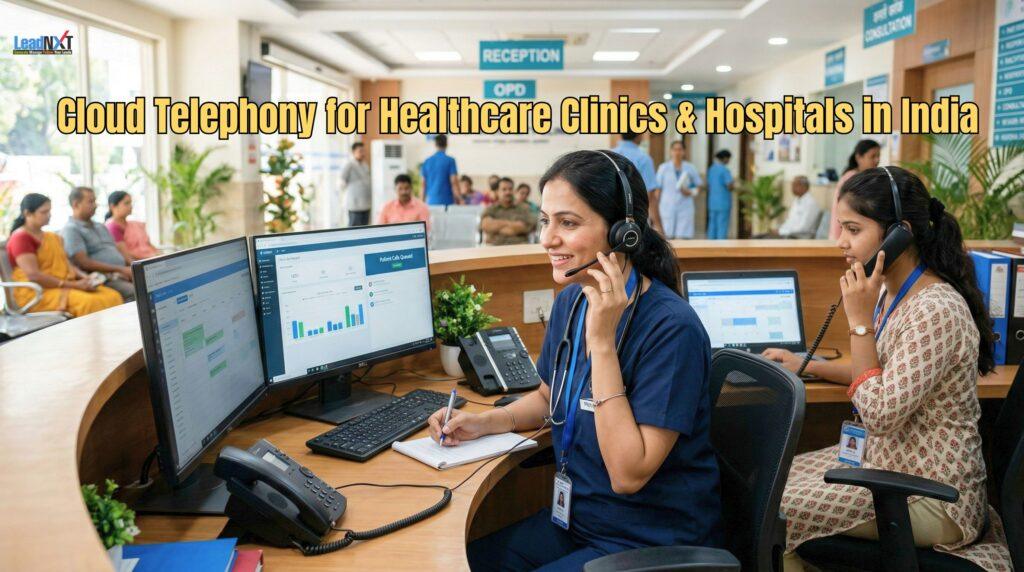
Cloud Telephony for Healthcare Clinics & Hospitals in India
Published by Team LeadNXT | www.leadnxt.com | March 27, 2026
India’s healthcare industry is booming. With over 1.4 billion people relying on a growing network of hospitals, clinics, diagnostic labs, and telemedicine platforms, the demand for efficient, reliable communication systems has never been higher.
Yet, most healthcare providers in India still rely on outdated phone systems, manual appointment booking, and fragmented patient communication. The result? Missed appointments, frustrated patients, overwhelmed reception desks, and lost revenue.
The solution? Cloud telephony – a modern, internet-based communication system that automates calls, messages, and patient engagement without expensive hardware or IT teams.
What Is Cloud Telephony and How Does It Work for Healthcare?
Cloud telephony is a technology that moves your phone system to the cloud. Instead of physical PBX boxes and tangled wires, everything runs over the internet. Calls are routed, recorded, and managed through a software platform that works on any device – desktop, mobile, or tablet.
For healthcare, this means a hospital or clinic can set up a professional IVR system, virtual numbers, WhatsApp messaging, and automated reminders – all managed from a single dashboard.
Platforms like LeadNXT provide an all-in-one cloud telephony and CRM solution specifically designed for Indian businesses, including healthcare providers.
Why Healthcare Needs Cloud Telephony in 2026
The Indian healthcare landscape has changed dramatically. Patients now expect the same convenience from their doctor’s office that they get from e-commerce platforms. Here’s why cloud telephony for hospitals is no longer optional:
1. Patients Expect Instant Responses
When someone calls a hospital for an emergency or appointment, being put on hold for 10 minutes is unacceptable. An IVR system ensures every call is answered instantly and routed to the right department – OPD, emergency, pharmacy, or billing.
2. Missed Calls = Missed Patients
Research shows that 62% of patients who can’t reach a clinic on the first call will try a competitor. Cloud telephony captures every missed call and triggers an automatic WhatsApp message or callback, ensuring no patient inquiry is lost.
3. Manual Scheduling Is Broken
Front-desk staff juggling phone calls, walk-ins, and paperwork leads to double bookings and errors. Automated IVR-based appointment scheduling eliminates this chaos.
4. Multi-Location Management
Hospital chains with multiple branches need centralized call management. Cloud telephony lets you route calls across locations using a single virtual number.
5. Compliance and Data Security
Patient data is sensitive. Cloud telephony platforms with built-in encryption and call recording help healthcare providers maintain compliance and quality standards.
Key Cloud Telephony Features for Healthcare
| Feature | Healthcare Application |
|---|---|
| Multi-Level IVR | Route calls to OPD, emergency, lab, pharmacy, billing departments |
| Appointment Scheduling | Patients book appointments via IVR or WhatsApp without calling reception |
| Automated Reminders | Send SMS/WhatsApp reminders for upcoming appointments, reducing no-shows by 30% |
| Missed Call Alerts | Auto-capture patient inquiries and trigger follow-up messages |
| Call Recording | Record all calls for quality assurance, training, and dispute resolution |
| WhatsApp Integration | Send reports, prescriptions, lab results, and follow-up instructions via WhatsApp |
| Virtual Numbers | Use a single number for all branches; route calls by location or department |
| CRM Integration | Maintain complete patient interaction history for personalized care |
| Feedback Collection | Post-visit IVR calls or WhatsApp surveys to gather patient feedback |
| Toll-Free Numbers | Make it free for patients to call, increasing inquiry volume |
How a Typical Healthcare Cloud Telephony Setup Works
Let’s walk through a real-world scenario of a multi-specialty hospital using LeadNXT’s cloud telephony platform:
Patient Calls Hospital Number: A patient calls the hospital’s virtual number. The IVR greets them: “Welcome to XYZ Hospital. Press 1 for OPD, Press 2 for Emergency, Press 3 for Lab Reports, Press 4 for Billing.”
Call Routing: Based on the patient’s input, the call is routed to the appropriate department. If all agents are busy, the patient is placed in a smart queue with estimated wait time.
Missed Call Follow-Up: If the patient hangs up before connecting, the system instantly sends a WhatsApp message: “Hi [Name], we noticed you tried to reach us. Book an appointment here: [link].” Learn how WhatsApp chatbot templates can automate these conversations.
Appointment Confirmation: Once the appointment is booked, the patient receives a WhatsApp confirmation with doctor name, time, location, and directions.
Pre-Visit Reminder: 24 hours before the appointment, an automated reminder is sent via SMS and WhatsApp, reducing no-shows.
Post-Visit Follow-Up: After the visit, the patient receives a feedback survey via IVR call or WhatsApp, along with prescription details and follow-up instructions.
Cloud Telephony vs. Traditional Phone Systems for Hospitals
| Parameter | Traditional System | Cloud Telephony (LeadNXT) |
|---|---|---|
| Setup Cost | High (hardware, wiring, PBX) | Low (no hardware needed) |
| Setup Time | Weeks to months | 24 hours or less |
| Scalability | Limited (needs new hardware) | Unlimited (add lines instantly) |
| Remote Access | Not possible | Access from anywhere |
| Call Recording | Requires additional equipment | Built-in |
| WhatsApp Integration | Not available | Native support |
| CRM & Analytics | Separate system needed | Integrated dashboard |
| Maintenance | Ongoing IT costs | Zero maintenance |
The shift to cloud is not just about technology – it’s about better patient experience and operational efficiency. Here’s why every business should switch to cloud telephony by 2026.
Real Results: What Healthcare Providers Achieve with LeadNXT
Healthcare providers using LeadNXT have seen measurable improvements:
40% reduction in missed appointments – thanks to automated WhatsApp and SMS reminders.
3x faster response time – IVR routes calls instantly without manual intervention.
50% increase in patient inquiries – with toll-free numbers and missed call capture.
30% reduction in front-desk workload – through self-service IVR appointment booking.
Higher patient satisfaction scores – with personalized follow-ups and feedback collection.
Choosing the Right Cloud Telephony Provider for Healthcare
Not all cloud telephony platforms are created equal. For healthcare, you need a provider that understands the unique demands of the industry. Here’s what to look for:
HIPAA-Ready Security: Patient data must be protected with encryption at rest and in transit.
WhatsApp Business API: Official API access for reliable, template-based messaging. See WhatsApp Business API pricing in India.
Multi-Level IVR: Support for complex departmental routing.
CRM Integration: Complete patient journey tracking from first call to follow-up.
AI Chatbot: Automate routine queries like lab hours, doctor availability, and directions. Learn more about AI chatbots for Indian businesses.
Affordable Pricing: Flexible plans that suit small clinics and large hospital chains alike.
LeadNXT checks every box – offering a unified cloud call center solution with IVR, WhatsApp, CRM, and AI automation tailored for Indian healthcare providers.
Transform Your Hospital’s Communication Today
Join hundreds of healthcare providers across India who trust LeadNXT for their cloud telephony needs.
Frequently Asked Questions (FAQs)
Q1: Is cloud telephony suitable for small clinics?
Yes. Cloud telephony is scalable and affordable. Even a single-doctor clinic can benefit from IVR, automated reminders, and WhatsApp messaging. LeadNXT offers plans for all sizes.
Q2: Can patients book appointments through IVR?
Absolutely. Patients can select their department, preferred doctor, and time slot directly through the IVR menu. A confirmation is then sent via WhatsApp.
Q3: Is patient data secure with cloud telephony?
Yes. Reputable providers like LeadNXT use end-to-end encryption, secure data centers, and access controls to protect patient information.
Q4: Can I send lab reports and prescriptions via WhatsApp?
Yes. With WhatsApp Business API integration, you can send PDFs, images, and documents directly to patients’ WhatsApp – with their consent.
Q5: How long does it take to set up?
With LeadNXT, most healthcare setups are live within 24 hours.
Conclusion
Healthcare in India is evolving fast, and patient expectations are higher than ever. Cloud telephony bridges the gap between modern patient demands and efficient hospital operations – enabling 24/7 availability, automated appointment scheduling, instant WhatsApp communication, and data-driven decision-making.
Whether you run a small clinic or a multi-branch hospital chain, LeadNXT’s cloud telephony platform provides everything you need to deliver a world-class patient experience while reducing costs and workload.
The future of healthcare communication is in the cloud. Make the switch today.
Ready to modernize your hospital’s communication? Contact LeadNXT for a personalized demo.
Related Posts:
➡ Cloud Telephony for Travel Agencies – Complete Solution
➡ Why Every Business Should Switch to Cloud Telephony by 2026
➡ AI Marketing Automation Platform for Business
➡ Buyer Behaviour in India: Why Instant Communication Decides Conversions
Recommended Reading
For a deeper understanding of this topic, explore our complete guides:
Related Articles
Join Franchise Programme of LeadNXT a Premium Partnership
LeadNXT, is a next generation service platform which delivers cloud computing services to ease the…
Cloud Telephony Company LeadNXT is Looking to Global Expansion in B2B Marketing
Leading cloud telephony company LeadNXT has set its sights on business-to-business (B2B) marketing through it’s…

LeadNXT’s Cloud Call Center & IVR Services
In today’s fast-paced, customer-driven world, businesses need efficient, scalable, and intelligent communication solutions to stay…