
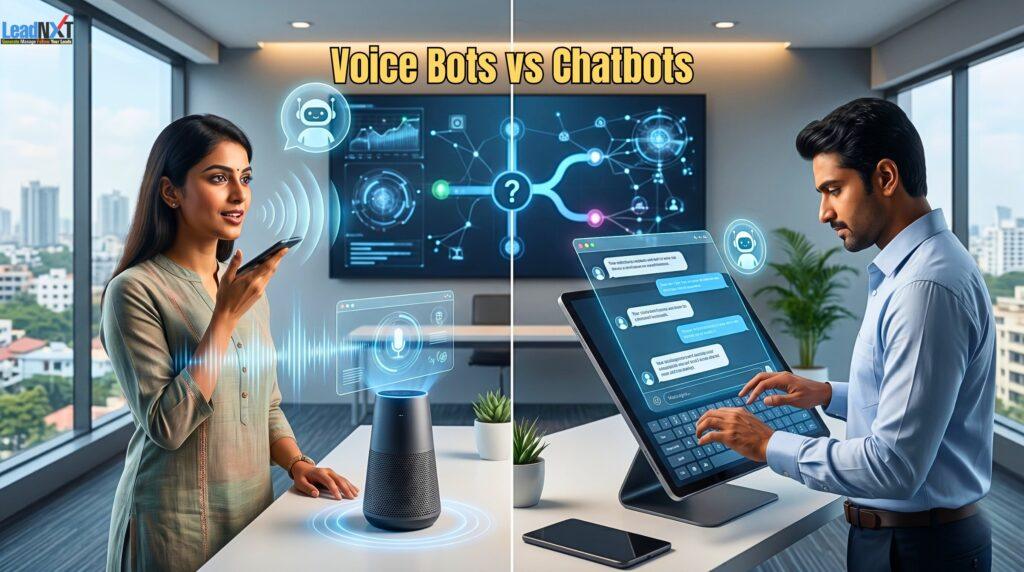
Voice Bots vs Chatbots
Published by Team LeadNXT | www.leadnxt.com | April 17, 2026
AI-powered communication is no longer the future – it’s the present. In 2026, businesses across India are rapidly adopting voice bots and chatbots to handle customer inquiries, generate leads, provide support, and drive sales.
But here’s the million-rupee question: Should your business use a voice bot, a chatbot, or both?
This comprehensive guide breaks down the differences between voice bots and chatbots, compares their strengths and weaknesses, and helps you decide the right fit for your business using real-world Indian use cases.
What Is a Chatbot?
A chatbot is a software application that simulates human conversation through text-based messaging. It works on platforms like WhatsApp, websites, Facebook Messenger, Instagram, and mobile apps.
Chatbots can be rule-based (following pre-set conversation flows) or AI-powered (using natural language processing to understand and respond to user intent).
For Indian businesses, WhatsApp chatbots have become the most popular choice due to WhatsApp’s massive user base. LeadNXT offers ready-to-use WhatsApp chatbot templates for 10 major industries.
What Is a Voice Bot?
A voice bot (also called a conversational IVR or AI voice assistant) is a software that interacts with users through spoken conversation over phone calls. It uses speech recognition, natural language understanding (NLU), and text-to-speech (TTS) to understand what the caller says and respond naturally.
Voice bots are the next evolution of traditional IVR systems. Instead of “Press 1 for Sales,” a voice bot allows callers to simply say, “I want to book an appointment” — and it handles the rest.
Voice Bot vs Chatbot: Head-to-Head Comparison
| Parameter | Chatbot | Voice Bot |
|---|---|---|
| Communication Channel | Text (WhatsApp, website, apps) | Voice (phone calls) |
| User Input | Typed text, button clicks | Spoken words |
| Response Speed | Instant text replies | Real-time voice replies |
| Accessibility | Requires smartphone + internet | Works on any phone (even feature phones) |
| Language Support | Multi-language text | Multi-language voice (Hindi, Tamil, etc.) |
| Rich Media | Images, PDFs, videos, buttons | Voice-only (no visuals) |
| Cost | Lower (messaging API costs) | Higher (telephony + speech processing) |
| Best For | Lead capture, support, e-commerce | Outbound calls, reminders, surveys |
| User Preference (India) | Preferred by younger, urban users | Preferred by older, semi-urban/rural users |
| Complexity Handling | Good for structured flows | Better for free-form conversations |
When to Use a Chatbot
Chatbots excel in scenarios where text-based communication is natural and preferred:
Lead Generation & Qualification
A WhatsApp chatbot can engage website visitors or ad clickers, ask qualifying questions, and capture lead details — all without human intervention. This is particularly effective for e-commerce businesses using WhatsApp API.
Customer Support & FAQs
Handle common questions like order status, return policies, pricing, and store hours automatically. Chatbots can resolve 70-80% of support queries without a live agent.
Appointment Booking
Clinics, salons, and service businesses can let customers book appointments through a chatbot with date/time selection and instant confirmation.
Product Catalogs & Recommendations
E-commerce and retail businesses can use chatbots to showcase products, offer personalized recommendations, and process orders directly in WhatsApp.
Marketing Campaigns
Send broadcast messages, promotions, and drip campaigns to segmented audiences. Chatbots turn marketing into a two-way conversation. Learn more about AI marketing automation.
When to Use a Voice Bot
Voice bots shine in scenarios where speaking is faster, more accessible, or more personal than typing:
Outbound Calling Campaigns
Voice bots can make thousands of outbound calls simultaneously — for payment reminders, appointment confirmations, survey collection, or promotional offers.
IVR Enhancement
Replace rigid “Press 1 for…” menus with conversational AI. Callers speak naturally, and the voice bot routes them to the right department or provides instant answers.
Regional Language Support
In India, where hundreds of millions of users are more comfortable speaking Hindi, Tamil, Telugu, or Marathi than typing in English, voice bots break the language barrier.
Accessibility for Non-Smartphone Users
Voice bots work on basic feature phones — no internet or app required. This is critical for reaching India’s rural and semi-urban population.
Urgent or Emotional Scenarios
Healthcare emergencies, insurance claims, and complaint escalations are better handled by voice — where tone and empathy matter.
The Best of Both Worlds: Why Smart Businesses Use Both
The Verdict
In 2026, the question isn’t “voice bot OR chatbot” — it’s “voice bot AND chatbot.” The smartest Indian businesses use both, connected through a unified platform, to cover every customer touchpoint.
Here’s how a unified approach works:
Customer calls your number → Voice bot handles the conversation, captures intent, and provides answers. If needed, it escalates to a live agent.
After the call → The system sends a WhatsApp message with a summary, documents, or a follow-up chatbot flow.
Customer messages on WhatsApp → Chatbot handles the inquiry, qualifies the lead, and books a callback if the customer wants to speak to someone.
All interactions are logged → In a single CRM dashboard, giving your sales and support teams complete context.
This is exactly what LeadNXT enables — a unified cloud call center platform that combines voice bots, WhatsApp chatbots, IVR, CRM, and AI automation under one roof.
Industry-Wise Recommendations
| Industry | Primary Bot | Why |
|---|---|---|
| Real Estate | Chatbot + Voice Bot | Chatbot for brochures & booking; voice bot for follow-ups. See real estate automation trends |
| Healthcare | Voice Bot + Chatbot | Voice for appointments & emergencies; chatbot for reports & reminders |
| E-Commerce | Chatbot | Product browsing, orders, and tracking are visual and text-friendly |
| Education | Chatbot + Voice Bot | Chatbot for course info; voice bot for parent calls in regional languages |
| Travel | Chatbot | Itineraries, bookings, and confirmations work best as text/media. See cloud telephony for travel agencies |
| Insurance | Voice Bot | Policy explanations and claims require conversational depth |
| Banking/Finance | Voice Bot + Chatbot | Voice for KYC and verification; chatbot for balance and transactions |
| Elections/Political | Voice Bot | Mass outreach to voters in regional languages. See election management software |
Cost Comparison: Voice Bot vs Chatbot
| Cost Factor | Chatbot | Voice Bot |
|---|---|---|
| Platform Cost | Low to Medium | Medium to High |
| Per-Interaction Cost | Low (WhatsApp API charges) | Higher (telephony minutes) |
| Development Time | Days to weeks | Weeks to months |
| Maintenance | Low | Medium |
| ROI Timeline | 1-3 months | 3-6 months |
For most Indian SMBs starting their AI journey, chatbots offer the fastest ROI. Voice bots are ideal as a second phase — especially for businesses with high call volumes. Check WhatsApp Business API pricing in India for chatbot costs.
Get Voice Bot + Chatbot in One Platform
LeadNXT combines IVR voice bots, WhatsApp chatbots, CRM, and AI automation — everything you need for 360-degree customer communication.
Frequently Asked Questions (FAQs)
Q1: Can a chatbot handle calls too?
No. Chatbots handle text-based messaging only. For voice calls, you need a voice bot or IVR system. LeadNXT offers both integrated in a single platform.
Q2: Which is cheaper — a voice bot or chatbot?
Chatbots are generally cheaper to deploy and operate due to lower per-message costs. Voice bots have higher telephony costs but are essential for call-heavy businesses.
Q3: Can I use both on the same platform?
Yes. Platforms like LeadNXT’s cloud call center solution integrate both voice and chat automation under one dashboard.
Q4: Do voice bots support Indian languages?
Yes. Modern voice bots support Hindi, Tamil, Telugu, Bengali, Marathi, and many more Indian languages through advanced speech recognition.
Q5: How do I get started?
Start with a WhatsApp chatbot for lead capture and support. Then add a voice bot for outbound calls and IVR enhancement. Contact LeadNXT for a free consultation.
Conclusion
In 2026, AI-powered voice bots and chatbots are not competing technologies — they’re complementary. Chatbots handle the text-based, visual, always-on communication that today’s customers expect. Voice bots bring the warmth, accessibility, and depth of spoken conversation that millions of Indian users prefer.
The winning strategy? Deploy both through a unified platform like LeadNXT that connects voice, WhatsApp, CRM, and AI — giving your customers the freedom to engage on their terms while your business captures every opportunity.
Related Posts:
➡ AI Chatbots for Indian Businesses: The Ultimate 2026 Guide
➡ WhatsApp Chatbot Templates for 10 Major Industries
➡ Why Every Business Should Switch to Cloud Telephony by 2026
Related Articles

How an AI-Powered CRM for Lead Tracking Can Transform Your Sales Funnel
In today’s high-speed digital sales environment, tracking leads manually is no longer viable—especially for startups…

Cloud Telephony Solutions in India: The Ultimate 2026 Guide for Business Communication
India’s business communication landscape is undergoing a massive transformation. From startups in Bengaluru to large…

The Role of AI in B2B Lead Generation and Sales Automation
Staying ahead in today’s highly competitive B2B landscape demands more than just traditional prospecting—it requires…