

Why 2026 Will Be the Year of AI-Powered Contact Centers
The way businesses communicate with customers is undergoing a massive transformation. Traditional call centers that relied heavily on human agents, manual routing, and reactive support models are rapidly becoming outdated. As we move closer to 2026, AI-powered contact centers are no longer a future concept-they are becoming the new industry standard.
In 2026, customer expectations will be higher than ever. People will expect instant responses, personalized conversations, and seamless experiences across voice, chat, WhatsApp, SMS, and RCS. To meet these demands, businesses will increasingly adopt cloud call center solutions powered by artificial intelligence.
This shift is not just about automation-it’s about intelligent communication. AI agents, predictive call routing, advanced voice analytics, and emotion detection will redefine how brands connect with customers, reduce costs, and drive higher satisfaction.
Let’s explore why 2026 will be the breakout year for AI contact centers and why businesses that adopt early will gain a strong competitive advantage.
The Evolution of Contact Centers: From Reactive to Intelligent
Traditional contact centers were designed to react. A customer calls, waits in a queue, speaks to an available agent, and hopes for a resolution. This model is inefficient, expensive, and frustrating for both customers and agents.
By contrast, AI-powered contact centers operate proactively and intelligently. They use real-time data, customer history, and predictive insights to:
- Route calls intelligently
- Resolve common queries automatically
- Detect customer emotions
- Assist agents with real-time suggestions
In 2026, businesses will no longer ask whether to adopt AI contact centers-but how fast they can transition.
AI Agents: The New Frontline of Customer Support
One of the biggest drivers behind AI contact centers is the rise of AI agents (also called virtual agents or voice bots).
What Are AI Agents?
AI agents are intelligent voice or chat systems that can:
- Answer customer queries 24×7
- Understand natural language
- Handle bookings, payments, complaints, and FAQs
- Escalate complex cases to human agents
Unlike basic IVR systems, AI agents use Natural Language Processing (NLP) and machine learning to understand intent rather than relying on rigid menu options.
Why AI Agents Will Dominate in 2026
By 2026:
- Businesses will face higher call volumes across multiple channels
- Customers will expect instant responses, even outside business hours
- Hiring and retaining human agents will become more expensive
AI agents will act as the first line of support, resolving up to 60–70% of routine queries without human intervention. This allows human agents to focus on high-value, complex interactions.
For enterprises using cloud call center solutions, AI agents will become a built-in capability rather than an add-on.
Predictive Routing: Connecting Customers to the Right Agent Instantly
In traditional call centers, calls are routed based on availability-not suitability. This leads to:
- Multiple call transfers
- Repeated explanations
- Longer handling times
What Is Predictive Routing?
Predictive routing uses AI algorithms to analyze:
- Caller history
- Past interactions
- Language preference
- Issue type
- Agent expertise and performance
Based on this data, the system predicts which agent is most likely to resolve the issue successfully and routes the call accordingly.
Why Predictive Routing Matters in 2026
In 2026, speed and accuracy will define customer experience. Predictive routing will:
- Reduce average handling time (AHT)
- Increase first-call resolution (FCR)
- Improve customer satisfaction scores (CSAT)
- Reduce agent burnout
Modern AI contact center platforms like LeadNXT’s cloud solutions will use predictive routing as a standard feature, not a premium option.
Voice Analytics: Turning Conversations into Actionable Insights
Every customer conversation is a goldmine of data. However, most traditional contact centers fail to capture or analyze this information effectively.
What Is Voice Analytics?
Voice analytics uses AI to analyze recorded or real-time calls for:
- Keywords and phrases
- Customer intent
- Compliance adherence
- Call quality
- Agent performance
In advanced cloud call center solutions, voice analytics goes beyond transcription-it extracts insights.
How Voice Analytics Will Transform Contact Centers in 2026
By 2026, businesses will use voice analytics to:
- Identify recurring customer issues
- Improve scripts and workflows
- Detect upsell and cross-sell opportunities
- Monitor compliance automatically
- Measure sentiment trends over time
Instead of guessing what customers want, AI-powered analytics will provide data-backed clarity.
Emotion Detection: Understanding How Customers Feel
One of the most revolutionary advancements in AI contact centers is emotion detection.
What Is Emotion Detection in Voice Calls?
Emotion detection technology analyzes:
- Tone of voice
- Pitch and pace
- Speech patterns
- Pauses and stress indicators
Using these signals, AI can identify whether a customer is:
- Angry
- Frustrated
- Confused
- Neutral
- Happy
Why Emotion Detection Is a Game-Changer
In 2026, customer experience will be judged not just by resolution-but by empathy.
Emotion detection allows contact centers to:
- Escalate angry customers immediately
- Trigger supervisor alerts in real time
- Adjust AI or agent responses dynamically
- Train agents using real emotional data
This level of emotional intelligence will separate average call centers from next-generation AI contact centers.
Cloud Call Center Solutions: The Foundation of AI Transformation
None of these AI capabilities are possible without a cloud-based infrastructure.
Why Cloud Call Centers Are Essential for 2026
Traditional on-premise systems lack flexibility and scalability. In contrast, cloud call center solutions offer:
- Instant scalability
- Easy AI integration
- Remote agent enablement
- Centralized analytics
- Lower infrastructure costs
By 2026, businesses will prefer cloud platforms that offer AI-first architecture, enabling rapid deployment of new features like AI agents, predictive routing, and analytics.
AI Contact Centers Reduce Costs While Improving CX
One of the biggest myths is that AI contact centers are expensive. In reality, they significantly reduce operational costs.
Key Cost Benefits
- Fewer human agents needed for routine queries
- Lower training and onboarding costs
- Reduced call handling time
- Fewer repeat calls
- Better resource utilization
At the same time, AI contact centers improve:
- Response times
- Personalization
- Availability
- Customer satisfaction
This dual benefit makes AI contact center adoption inevitable by 2026.
Industries Leading AI Contact Center Adoption
By 2026, AI-powered contact centers will be widely adopted across industries such as:
- Real Estate – automated lead qualification and follow-ups
- Healthcare – appointment booking and patient support
- Banking & Finance – fraud detection and secure support
- E-commerce – order tracking and returns
- Telecom – issue resolution and retention
Any industry dealing with high customer interaction will rely on AI contact center platforms for scale and efficiency.
Why Businesses Should Prepare Now
Waiting until 2026 to adopt AI contact centers could mean:
- Higher customer churn
- Lower CSAT scores
- Higher operational costs
- Competitive disadvantage
Early adopters will gain:
- Better customer insights
- Scalable communication infrastructure
- Stronger brand trust
- Higher conversion rates
Platforms like LeadNXT are already enabling businesses to transition smoothly with AI-powered cloud call center solutions tailored for Indian enterprises.
Conclusion: 2026 Is the Turning Point
2026 will not be just another year of digital transformation-it will be the year AI-powered contact centers become the norm.
With AI agents handling routine queries, predictive routing ensuring faster resolutions, voice analytics unlocking insights, and emotion detection enabling empathy at scale, businesses will redefine customer engagement.
Organizations that invest in cloud call center solutions and adopt an AI contact center strategy today will be the ones leading their industries tomorrow.
The future of customer communication is intelligent, automated, and human-centric-and it starts now.
Related Articles
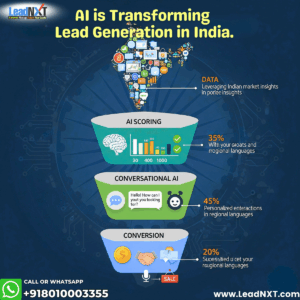
How AI is Transforming Lead Generation in India.
How AI is Transforming Lead Generation in India Artificial Intelligence (AI) is no longer just…

AI Chatbots for Indian Businesses: The Ultimate 2026 Guide to Boosting Growth and Efficiency
The Ultimate 2026 Guide to Boosting Growth and Efficiency Imagine it’s Diwali sale season. Your…
LeadNXT – Bringing a New Concept of Automation
For effective growth of a business, generation of leads and conversions is very crucial and…